Designing for simplicity at scale, from 0 to 1M users.
How we transformed access to the permaweb from a single chokepoint into a decentralized, operator-first gateway network — shipping a modular dashboard for staking, node ops, retrieval, manifests, and ArNS.
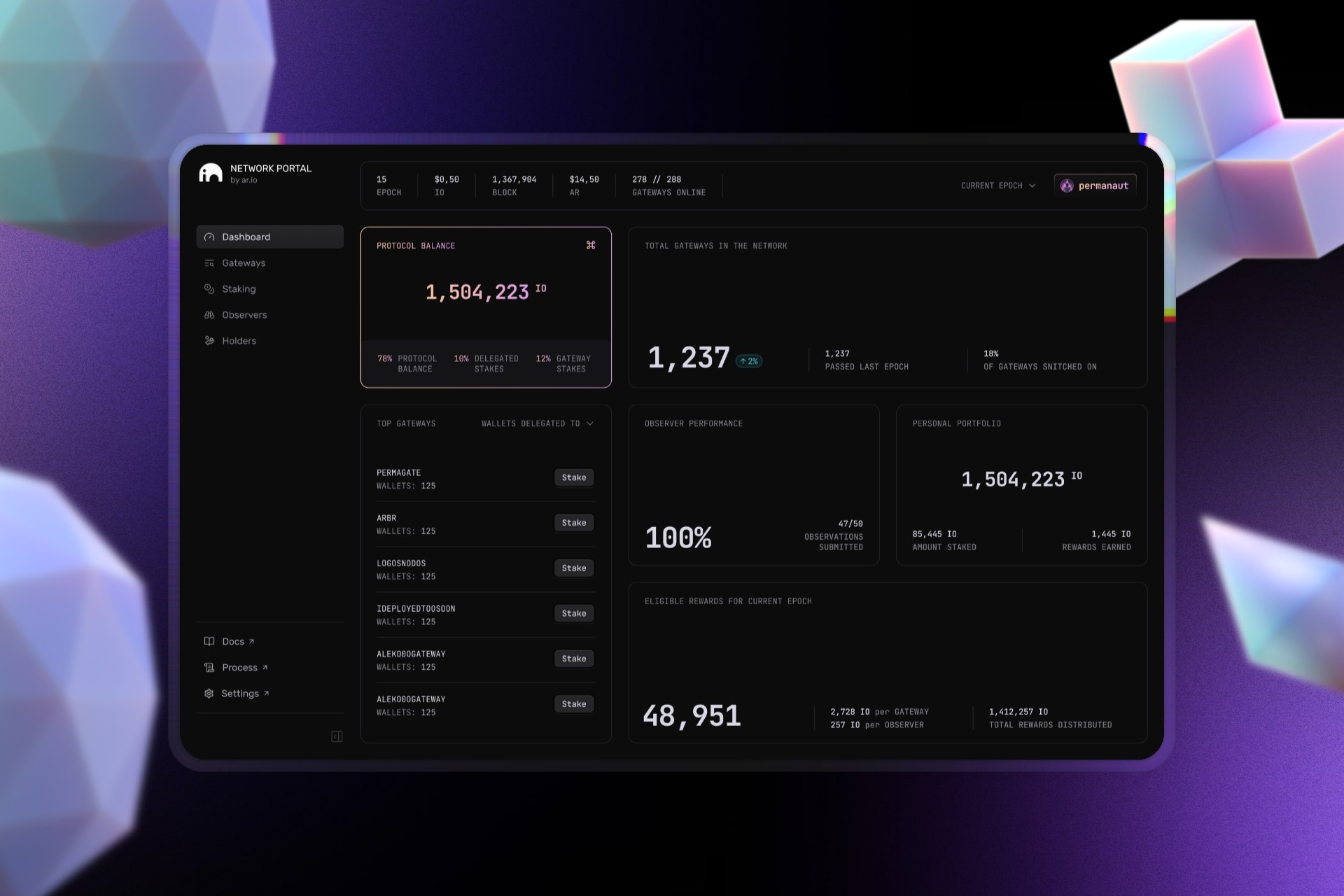
We transformed access to the permaweb from a single chokepoint into a decentralized, operator-first gateway network — shipping a modular dashboard for staking, node operations, retrieval, manifests, and ArNS.
- 0 → 1M+ active users on the network
- 20+ ecosystem integrations
- Hours → mins app deploy time via manifests
Context
Arweave is a global, permissionless permanent data store. AR.IO sits on top, with a decentralized gateway protocol that lets anyone run a node and serve the permaweb. The job: make running and using gateways straightforward — from Raspberry Pis at home to multi-region cloud operators.
The problems
- Centralized chokepoint. One primary gateway limited reliability, choice, and innovation.
- Operational complexity. Running a node required deep protocol knowledge.
- Fragmented developer experience. Indexing, manifests, and name resolution were powerful but hard to use.
- Trust & incentives. Operators needed clear economics; users needed predictable, fast retrieval.
Objectives
- Decentralize access without sacrificing speed or reliability.
- Lower the barrier to operate and configure gateways — UI-first ops.
- Unify the developer surface for writing, retrieval, manifests, and ArNS resolution.
- Design for scale: a modular architecture supporting many gateway types.
- Grow the ecosystem: unlock integrations, community participation, and network effects.
Strategy
We anchored on five moves: modular by default (interchangeable core components), operator-first UX (one dashboard for staking, health, seeding, caching, pricing, rewards), developer ergonomics (consistent APIs and manifest tooling), transparent network incentives, and open source (verifiable, extensible, community-driven).
The solution
A 0→1 Gateway Dashboard that put the entire operating surface in one place: staking & rewards, write/proxy, retrieval & caching, indexing controls, manifests, ArNS resolution, observability, and team roles & policies. Underneath, a swappable architecture made it easy for community builders to specialize gateways for content domains, pricing models, or geography.
Product principles
- Permanent-first. The UX communicates permanence, integrity, verifiability.
- Sovereignty with safety. Empower customization while surfacing best-practice defaults.
- Progressive disclosure. Beginner-friendly paths with expert controls one click deeper.
- Operational clarity. Make indexing, pricing, and rewards legible and predictable.
- Low-friction scale. Laptop → cluster without re-learning the product.
Design direction
Dark-first, high-contrast UI that feels technical without feeling hostile. Minimal chrome, generous spacing, typography with clear hierarchy. Functional sans with wide numerals for telemetry; monospaced accents for hashes and IDs. Cards with soft depth, split-pane layouts, docked action bars. Lightweight line icons with motion-safe micro-animations.
Execution
- Discovery. Interviews with operators, builders, and partners.
- Opportunity mapping. Jobs-to-be-done prioritized by network impact.
- IA & flows. Modular IA, dashboards, wizards, manifest/ArNS workflows.
- Delivery. Weekly release trains; design tokens + component library; feature flags.
- Validation. Cohort rollouts; SLOs on retrieval latency and write inclusion.
Results
- Adoption: 0 → 1M+ active users across the network.
- Resilience: Decentralized access eliminates single points of failure.
- Performance: Materially faster, more predictable retrieval.
- Developer velocity: Manifest-based serving cut deployment from hours to minutes.
- Ecosystem: 20+ integrations including Meta, Solana Mobile, Metaplex, AO.
What was hard
- Balancing simplicity vs. power — exposing expert controls without overwhelming new operators.
- Designing transparent staking & reward UX amid evolving network dynamics.
- Supporting heterogeneous infra from Raspberry Pis to multi-region cloud clusters.
What I'd do next
- Policy packs — opinionated presets for specific use cases.
- A marketplace for gateway discovery by performance, coverage, SLA.
- Indexing blueprints with auto-tuning based on workload.
- Deeper analytics for cost forecasting and capacity planning.
- One-click manifest previews, linting, and incremental publishing.
AR.IO transformed the permaweb from a single chokepoint into a modular, decentralized access layer — making complex operations simple, and growing real usage and resilience across the ecosystem.